post post-impressionism ism
Jan. 1st, 2011 09:09 pm![[personal profile]](https://www.dreamwidth.org/img/silk/identity/user.png) calimac
calimacAs I was heading up in roughly that direction anyway, if the de Young Museum was kind enough to keep its current traveling exhibit of post-impressionist paintings from the Musée d’Orsay open on New Year's Day, I figured I might as well stop in and see it today, before it closes in three weeks. This isn't my favorite artistic period or style, but the chance to be up close and personal with Vincent van Gogh so close to home was not to be missed.
And indeed the van Goghs, about eight of them, were vivid as all get-out, especially this famous one, far more impressive in person, especially as you can see how three-dimensional it is, van Gogh's expressionism having expressed itself in the form of big gobs of paint on the canvas.
There were big crowds in front of the van Goghs, but that was OK, because like a lot of paintings of this sort, his look better the further away from them you are. You get close up to a van Gogh to study the master's technique, not to admire its beauty. For that you need to stand back.
You need to stand back even farther from the pointillists, led by "Sunday in the Park" Georges Seurat, and including other artists who used even bigger colored dots than he did. Get closer than six feet from one of those paintings and it disintegrates into an indecipherable pattern of colored halftones. I suppose that's the effect the painters wanted, but as someone who prefers fractal art, which looks more intricately detailed the closer you get to it, I find it a bit frustrating.
After van Gogh and the Seurat school, and some others including Monet - I'm sorry, I know this is a philistine reaction, but the impression that he simply needed to wipe his eyeglasses clean is indelible - the exhibit offers Cézanne and his followers, whose flat featureless colored shapes led eventually to cubism. (The exhibit includes one mid-period Picasso, to show what Cézanne wrought.) This section demonstrates that it's not the style that makes the painting, but what the artist does with it. Cézanne himself is OK by me, and Gaughin is better than OK, but some of the others struck me as less than proficient. One still-life by Paul Sérusier was accompanied by a caption admiring its volumeless geometric shapes that seem to hover over the background instead of sitting on it, which strikes me as a valiant but hopeless attempt to redefine a bug as a feature.
But down at the end of the hallway were two huge canvases by Henri Rousseau, including this one, which simply blow all of the competition out of the water. Same flat technique, but delivered with depth, and his stunning creativity shows that a great enough artist can make a masterpiece out of anything.
As long as I was there, I also spent some time in the de Young's permanent galleries. I saw two things I particularly liked there. On a wall full of 19th-century American landscape art was one painting, at first glance indistinguishable from the others, which was painted in 2001. It's by Sandow Birk and is titled "Fog Over San Quentin". It's dominated by shore rocks against a vast background of water and sky, but faintly in the distance you can spy the walls of the infamous prison, incongruous in the fog. There are images of this painting online, but they don't do it justice by a long shot.
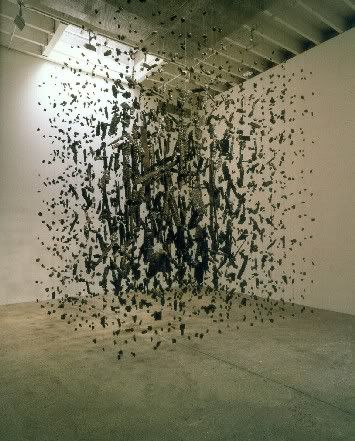
The other is Cornelia Parker, who did this. The charred wooden shards of a church burned by arson, suspended into a Shape, by wires that are invisible from the right angle. It looked pretty cool and almost inimitable, so it was a bit dampening to find on Googling that all her work looks like that.
And indeed the van Goghs, about eight of them, were vivid as all get-out, especially this famous one, far more impressive in person, especially as you can see how three-dimensional it is, van Gogh's expressionism having expressed itself in the form of big gobs of paint on the canvas.
There were big crowds in front of the van Goghs, but that was OK, because like a lot of paintings of this sort, his look better the further away from them you are. You get close up to a van Gogh to study the master's technique, not to admire its beauty. For that you need to stand back.
You need to stand back even farther from the pointillists, led by "Sunday in the Park" Georges Seurat, and including other artists who used even bigger colored dots than he did. Get closer than six feet from one of those paintings and it disintegrates into an indecipherable pattern of colored halftones. I suppose that's the effect the painters wanted, but as someone who prefers fractal art, which looks more intricately detailed the closer you get to it, I find it a bit frustrating.
After van Gogh and the Seurat school, and some others including Monet - I'm sorry, I know this is a philistine reaction, but the impression that he simply needed to wipe his eyeglasses clean is indelible - the exhibit offers Cézanne and his followers, whose flat featureless colored shapes led eventually to cubism. (The exhibit includes one mid-period Picasso, to show what Cézanne wrought.) This section demonstrates that it's not the style that makes the painting, but what the artist does with it. Cézanne himself is OK by me, and Gaughin is better than OK, but some of the others struck me as less than proficient. One still-life by Paul Sérusier was accompanied by a caption admiring its volumeless geometric shapes that seem to hover over the background instead of sitting on it, which strikes me as a valiant but hopeless attempt to redefine a bug as a feature.
But down at the end of the hallway were two huge canvases by Henri Rousseau, including this one, which simply blow all of the competition out of the water. Same flat technique, but delivered with depth, and his stunning creativity shows that a great enough artist can make a masterpiece out of anything.
As long as I was there, I also spent some time in the de Young's permanent galleries. I saw two things I particularly liked there. On a wall full of 19th-century American landscape art was one painting, at first glance indistinguishable from the others, which was painted in 2001. It's by Sandow Birk and is titled "Fog Over San Quentin". It's dominated by shore rocks against a vast background of water and sky, but faintly in the distance you can spy the walls of the infamous prison, incongruous in the fog. There are images of this painting online, but they don't do it justice by a long shot.
The other is Cornelia Parker, who did this. The charred wooden shards of a church burned by arson, suspended into a Shape, by wires that are invisible from the right angle. It looked pretty cool and almost inimitable, so it was a bit dampening to find on Googling that all her work looks like that.


![[identity profile]](https://www.dreamwidth.org/img/silk/identity/openid.png)




no subject
Date: 2011-01-02 01:56 pm (UTC)no subject
Date: 2011-01-02 05:16 pm (UTC)I've seen 14 Rothkos at once - in the Rothko Chapel, in Houston TX - and there was nothing cumulative about them. I have never felt so ripped off by a visit to an art exhibit, and this despite the fact that there is no entrance fee.
no subject
Date: 2011-01-02 05:24 pm (UTC)Yes - given that proviso, but I rather liked the Parkers for other reasons too. And, in fact, the differences between her variations on that theme also interested me.
I don't have so much truck with abstract expressionism, and Rothko is far from being my favourite painter, but the one time I felt I got him was at an exhibition in the Tate, some time in the '80s, and there it was definitely a question of cumulative effect. Chacun a son gout.
no subject
Date: 2011-01-02 10:26 pm (UTC)-MTD/neb