![[personal profile]](https://www.dreamwidth.org/img/silk/identity/user.png)
concert review: Music@Menlo
May. 10th, 2019 09:30 amSo as I explained while reviewing their previous offering, Music@Menlo is trying out a new format for its winter concerts, Focus Residencies. And evidently they like it, because they've scheduled two more for next winter's season.
In these, one of Menlo's regular musicians is asked to serve as guest artistic director for a program. This person chooses a topical theme, selects appropriate repertoire, and assigns performers. The resulting concert is preceded by a lecture on the theme.
This time I got to attend both the concert and the lecture, Thursday and Friday of last week, and that was the first of my three weekend concerts. The Curator (that's what they're called) was regular Menlo violinist Arnaud Sussmann, who explained at both events that he started with the performers: he wanted to play with his violin mentor Pamela Frank, and with Menlo's pretty fabulous violist, Paul Neubauer.
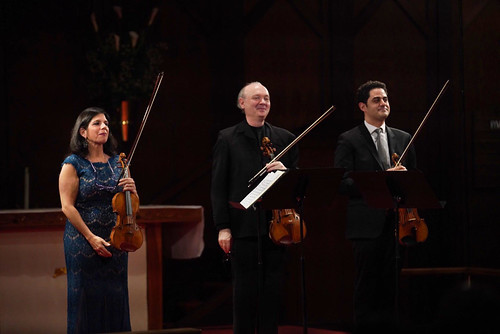
And here they are at work, l. to r. Frank, Neubauer, and Sussmann.

So, then, what great music is there for two violins and a viola? Sussmann could think of two often-played pieces by Antonín Dvořák and one by Zoltán Kodály, though curiously they're never all played together. On further search he found a couple more good ones by Sergei Taneyev and Eugène Ysaÿe, which made enough to form a concert.
And then he had a theme, too, because Dvořák, Kodály, and Taneyev - Czech, Hungarian, and Russian respectively - had one thing in common, that they were nationalist composers inspired by their own countries' folk music.
So we had a nice little concert in the bright precincts of St. Bede's Church with Dvořák's Terzetto and Four Miniatures, Kodály's Serenade Op. 12, Taneyev's Trio in D Op. 21, and Ysaÿe's Le Londres. The Ysaÿe, the non-folkish one of the bunch, was a challenging, counterpoint-heavy work with a lot of imitative work and an entire fugato.
The other pieces, the folk-influenced ones, were more ingratiating. The Taneyev, a hefty four-movement work, was a real find. It starts out sounding like a pastiche of Mozart, and then shifts into a more typical circa 1900 Russian style, though less heavy or bear-like than Tchaikovsky or the Mighty Five would do it. Taneyev hasn't gotten much respect since Harold Schonberg dismissed him as a sterile academician, but Schonberg hadn't heard much of Taneyev's music.
The Kodály was most notable for a slow movement dialogue, which begins with Sussmann's violin audibly laughing at Neubauer's viola's emotional pretense, all over a continuous tremolo from Frank on the unheralded other violin.
And the Dvořák pieces were full of Czech intensity, double-stops, frequent key changes, expressiveness, and - in the slow movements - weeping hesitations. The Miniatures were thicker and more intense, the Terzetto more lively and friendly.
Patrick Castillo gave the introductory lecture the previous evening in Stent Hall on the Menlo School campus. (Martin, the usual lecture venue on campus, had to be abandoned because the school was rehearsing Bye Bye Birdie just outside, and I was thinking, do today's students even believe that there once existed the culture depicted in that show? I can barely remember it and I don't believe it.) Some of his musical examples were recorded, but those which could be played by the three musicians of the concert live, were. So we got a preview of the concert.
What I found most interesting in his talk was his addressing of the scoring problem. He viewed this kind of trio as like a string quartet with the cello missing. So what do you do without your bass line? Several possible ways. One, you can use the viola as the bass, and that's a highly recommended procedure when you have the powerfully strong viola voice of Paul Neubauer at your disposal. That type of scoring in the concert worked exceptionally well. Another is to thicken the texture by playing a lot of double-stops. Ysaÿe really went for that one. And a third is to exploit the fact that violin and viola have similar timbre, and cluster them together in a medium-high range, defying the lack of cello.
Oh yes, we heard all those things, brilliantly rendered. Here, all you fine performers, take a curtain call:
In these, one of Menlo's regular musicians is asked to serve as guest artistic director for a program. This person chooses a topical theme, selects appropriate repertoire, and assigns performers. The resulting concert is preceded by a lecture on the theme.
This time I got to attend both the concert and the lecture, Thursday and Friday of last week, and that was the first of my three weekend concerts. The Curator (that's what they're called) was regular Menlo violinist Arnaud Sussmann, who explained at both events that he started with the performers: he wanted to play with his violin mentor Pamela Frank, and with Menlo's pretty fabulous violist, Paul Neubauer.
And here they are at work, l. to r. Frank, Neubauer, and Sussmann.
So, then, what great music is there for two violins and a viola? Sussmann could think of two often-played pieces by Antonín Dvořák and one by Zoltán Kodály, though curiously they're never all played together. On further search he found a couple more good ones by Sergei Taneyev and Eugène Ysaÿe, which made enough to form a concert.
And then he had a theme, too, because Dvořák, Kodály, and Taneyev - Czech, Hungarian, and Russian respectively - had one thing in common, that they were nationalist composers inspired by their own countries' folk music.
So we had a nice little concert in the bright precincts of St. Bede's Church with Dvořák's Terzetto and Four Miniatures, Kodály's Serenade Op. 12, Taneyev's Trio in D Op. 21, and Ysaÿe's Le Londres. The Ysaÿe, the non-folkish one of the bunch, was a challenging, counterpoint-heavy work with a lot of imitative work and an entire fugato.
The other pieces, the folk-influenced ones, were more ingratiating. The Taneyev, a hefty four-movement work, was a real find. It starts out sounding like a pastiche of Mozart, and then shifts into a more typical circa 1900 Russian style, though less heavy or bear-like than Tchaikovsky or the Mighty Five would do it. Taneyev hasn't gotten much respect since Harold Schonberg dismissed him as a sterile academician, but Schonberg hadn't heard much of Taneyev's music.
The Kodály was most notable for a slow movement dialogue, which begins with Sussmann's violin audibly laughing at Neubauer's viola's emotional pretense, all over a continuous tremolo from Frank on the unheralded other violin.
And the Dvořák pieces were full of Czech intensity, double-stops, frequent key changes, expressiveness, and - in the slow movements - weeping hesitations. The Miniatures were thicker and more intense, the Terzetto more lively and friendly.
Patrick Castillo gave the introductory lecture the previous evening in Stent Hall on the Menlo School campus. (Martin, the usual lecture venue on campus, had to be abandoned because the school was rehearsing Bye Bye Birdie just outside, and I was thinking, do today's students even believe that there once existed the culture depicted in that show? I can barely remember it and I don't believe it.) Some of his musical examples were recorded, but those which could be played by the three musicians of the concert live, were. So we got a preview of the concert.
What I found most interesting in his talk was his addressing of the scoring problem. He viewed this kind of trio as like a string quartet with the cello missing. So what do you do without your bass line? Several possible ways. One, you can use the viola as the bass, and that's a highly recommended procedure when you have the powerfully strong viola voice of Paul Neubauer at your disposal. That type of scoring in the concert worked exceptionally well. Another is to thicken the texture by playing a lot of double-stops. Ysaÿe really went for that one. And a third is to exploit the fact that violin and viola have similar timbre, and cluster them together in a medium-high range, defying the lack of cello.
Oh yes, we heard all those things, brilliantly rendered. Here, all you fine performers, take a curtain call:

